Continuous SEO monitoring: a practical workflow
field guide // , 5 min read, by Darthwares
Continuous SEO monitoring means checking whether important pages remain crawlable, useful and discoverable after every meaningful site change. A one-time audit is a snapshot; monitoring compares snapshots and tells you what changed. It does not by itself measure Google rankings or revenue, so the workflow pairs page-level checks with Search Console and analytics.
On this page // 4 sections
Why a passing launch audit is not enough
Sites change without a redesign. A content editor shortens a title, a template drops canonical tags, a deploy removes internal links, or a routing change starts returning an error. Each change may affect only a few URLs, so an aggregate site score can look stable while a valuable landing page deteriorates.
Google recommends using Search Console to investigate changes in clicks, impressions and affected pages. Those metrics tell you what happened in Google Search. A technical and content audit helps identify possible causes; neither data source alone proves causation. Comparing both is more useful than interpreting a score in isolation.
A monitoring loop you can actually run
Start with a known-good crawl of your public, indexable pages. Save the URL inventory, response status, canonical, title, description, structured data and internal-link relationships. Then schedule repeat crawls and compare the same URLs before looking at averages.
Treat the following as investigation triggers, not automatic proof of lost traffic:
- A previously reachable page becomes a 4xx, 5xx, redirect chain or accidental noindex.
- A canonical changes, a page disappears from the crawl, or inbound internal links vanish.
- A page-level quality score or answer-readiness estimate falls materially after a content edit.
- Search Console shows a sustained drop for the same query-page pair, beyond ordinary weekly variation.
Triage by exposure, then verify
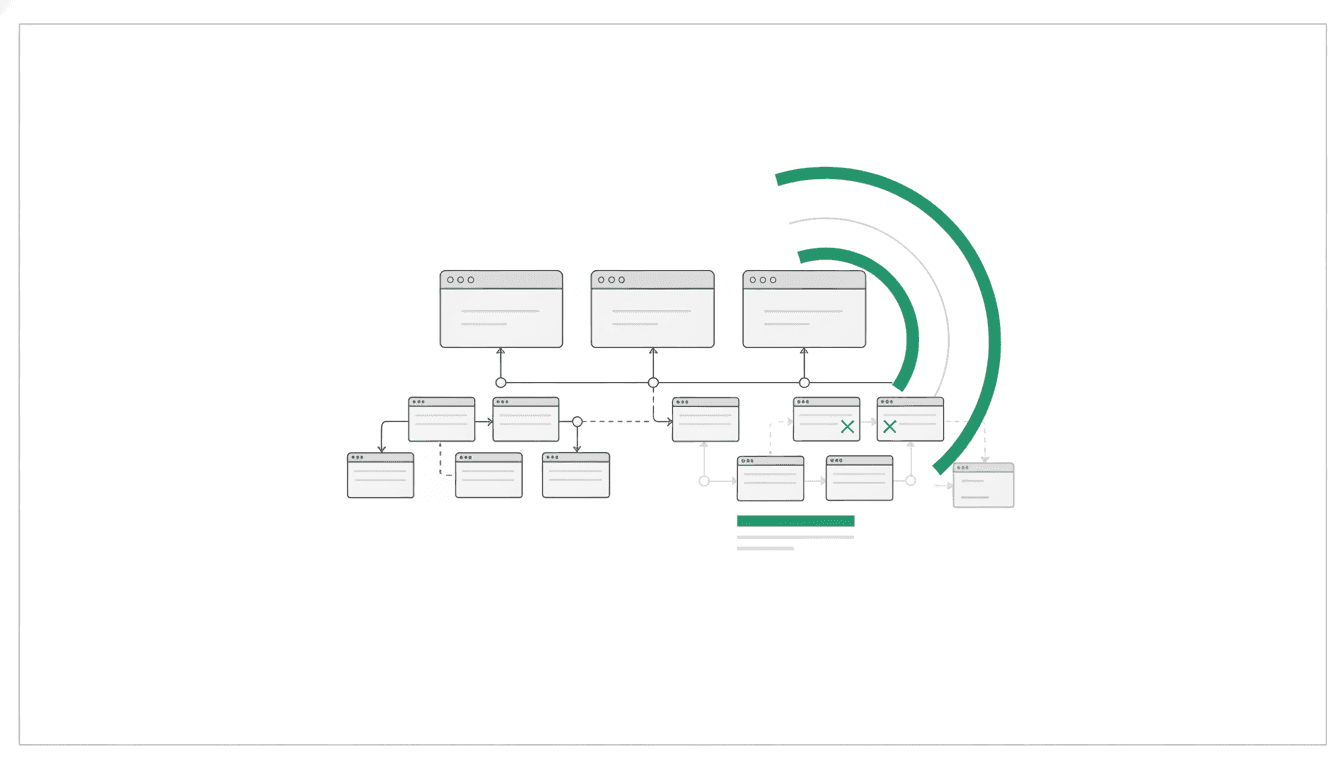
Prioritize a broken page that already attracts qualified organic visitors above a low-traffic page with a cosmetic title issue. In practice, useful prioritization needs three fields: what changed, how much valuable traffic the page previously earned, and how confident you are that the change caused the drop. The dot map helps show which pages and links changed; Search Console supplies impressions and clicks, while analytics supplies sessions and conversions.
After a fix, recrawl the affected URL and verify the HTML response, metadata and rendered content. Then watch search metrics over time. Search engines may recrawl and update results on their own schedule, so a repaired page should not be advertised as an immediate ranking recovery.
What dotmap measures—and what it does not
dotmap crawls reachable pages, runs deterministic technical checks and asks Jev to estimate content quality and answer readiness. Signed-in runs can save history and compare audits. These are diagnostic signals, not observed rankings, AI citations, traffic or sales. A strong score means the inspected pages satisfy this published rubric; it is not a guarantee of distribution.
Our own site is the test bed. We use the same audit to find weak URLs, improve the copy and technical details, then publish the measured before-and-after result. Keeping the failures visible is more useful than hiding them behind an attractive average.
Primary sources and further reading
Prepared with AI-assisted drafting and checked against the primary sources below. These sources support the platform and measurement claims; the examples and recommendations are dotmap analysis, not results reported by the sources.