When SEO fidelity slips, what is revenue at risk?
research note // , 6 min read, by Darthwares
SEO fidelity is the degree to which a site continues to deliver the content, technical signals and internal pathways it intended to publish. A regression can put revenue at risk when it affects pages that generate qualified organic demand. The risk is real, but a drop in an audit score is not itself a measured loss of revenue; attribution requires search and conversion data.
On this page // 4 sections
The chain from a page change to a business outcome
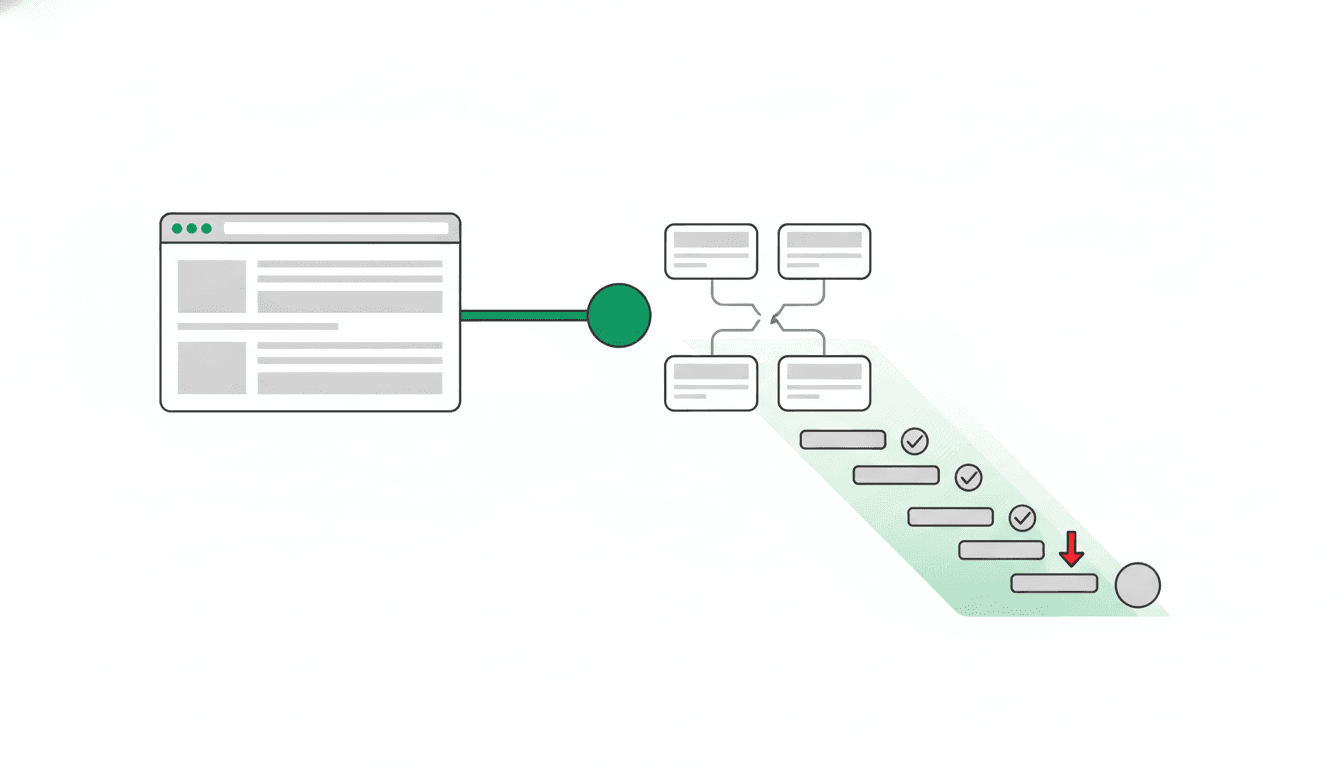
A template bug can make a product or service page unavailable, remove its canonical, or strip the answer people came to read. Search engines may then see a different page, and visitors may have a worse experience. If fewer qualified people arrive or convert, the business can lose opportunities. Each arrow in that chain needs evidence: crawl output for the page change, Search Console for search visibility and clicks, and analytics or CRM data for conversions and value.
Google's own guidance recommends combining Search Console performance data with Google Analytics because the former captures activity before a visit and the latter captures behavior after arrival. Google also cautions that clicks and sessions are different measurements. A diagnosis that ignores that distinction may overstate the financial impact.
A transparent exposure calculation
A useful planning estimate is: lost organic sessions × historical conversion rate × average value per conversion. Suppose a landing-page group had 10,000 comparable organic sessions per month, a 2% lead conversion rate, and $50 in expected value per lead. If comparable sessions fall by 10%, the modeled exposure is 1,000 × 2% × $50 = $1,000 for that month. This is an illustration, not a dotmap customer result and not proof that SEO caused the decline.
For a credible estimate, compare the same pages, device mix and season; exclude tracking outages; check whether paid, direct or referral traffic changed too; and show a range rather than one exact number. If the page never generated conversions, fixing it may still improve user experience, but attaching a dollar amount would be speculative.
Where constant monitoring earns its keep
A weekly page-level comparison can shorten the time between a regression and its discovery. It is especially valuable for pages that support ads, campaigns, sales enablement or product launches, because a broken destination can waste existing marketing effort even before search visibility changes. Use alerts for high-impact events—broken URLs, noindex, canonical drift or a large score change—and keep smaller editorial suggestions in a review queue.
A fast response is not the same as a guaranteed ranking recovery. Search results can change because of competition, demand, seasonality and Google's systems. Monitoring provides evidence for investigation and a verified fix; it cannot promise a particular position or revenue outcome.
Publish the measurement, not the fear
A marketing team should report the URL affected, the exact technical or content change, the date of the change, observed search clicks, observed conversions, and the method used to estimate financial exposure. If any link in that chain is missing, label the number as a scenario. That is the standard we use when discussing SEO fidelity on dotmap.
Primary sources and further reading
Prepared with AI-assisted drafting and checked against the primary sources below. These sources support the platform and measurement claims; the examples and recommendations are dotmap analysis, not results reported by the sources.